Why was I rejected for credit?
You applied for a card or a loan, waited, and got a no. If you were lucky there was a sentence of explanation attached. More likely there wasn’t. But understanding the reason is the first step to fixing it.
In this post I’ll explain what actually happens behind the scenes when a lender makes a decision, the two main ways people end up getting rejected, and what you can do about each one.
The two ways to get a no
Lenders want to lend to people who will pay them back. The hard part is working out who those people are before approving you for that new fancy credit card, or luxury car.
To do that, they pull together what they can find out about you. That usually means three things:
- your credit report from a credit bureau, which is a company that keeps a record of how you’ve handled credit in the past
- what you tell them when you apply, like your income
- anything they already know about you, if you have other products with them
All of that goes into a model. Some models are complicated and some are surprisingly simple, but they do the same job. They produce a score, unique to that lender, which is their estimate of how likely you are to actually pay back the money you want to borrow.
Then there’s a second layer that most people have never heard of. Lenders also have policy rules, which are fixed lines like “reject anyone with a bureau score below X” or “reject anyone earning less than Y”.
The rules don’t care what the model thinks. The model can decide you’re a very safe bet, and if your income is under the line you’re rejected anyway.
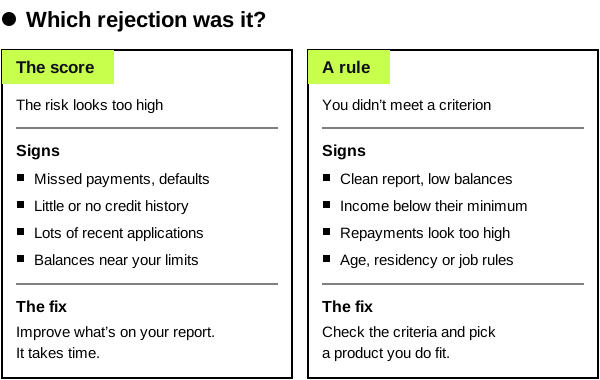
So a rejection comes from one of two places:
- The score. The lender thinks the chance of you not paying them back is too high.
- A rule. You don’t meet one of their fixed criteria.
The fixes are completely different, so it’s worth working out which one you hit. I’ll go through both.
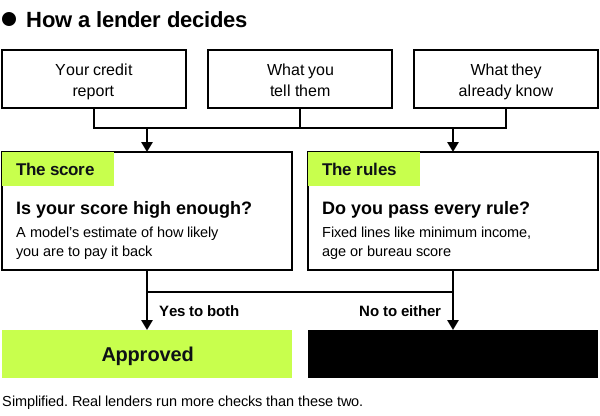
This is of course a simplified version of what lenders check. There are more steps, such as identity checks, affordability, and how much lending the business wants to do at the time. But the score and the rules are the place to start.
If it was the score
Four things do most of the damage here.
Bad credit history
This is usually the first thing a lender looks at. If they can see you’ve missed payments recently, or defaulted, they’ll assume you might do the same with them. Your score at the credit bureau normally drops as well, so you get marked down twice for the same thing.
It can recover. Paying on time, every time, over a long period makes the bad patch matter less and less. Setting up automatic payments for at least the minimum is the easiest way to make sure you never miss one by accident.
It is slow, though. There’s no shortcut, whatever anyone on TikTok tells you.
No history at all
This one catches a lot of younger people out, because it feels unfair. You’ve never missed a payment in your life! True, but you’ve never made one either, and the model has nothing to go on. With no information it can’t assume you’re safe, so an empty file often gets the same answer as a bad one.
The fix is to start building some history as early as you sensibly can. There are products made specifically for people in this position. It also helps to start with the bank you’re already with, because they can use what they already know about you. A lender you’ve never dealt with just sees a blank page.
Too many recent applications
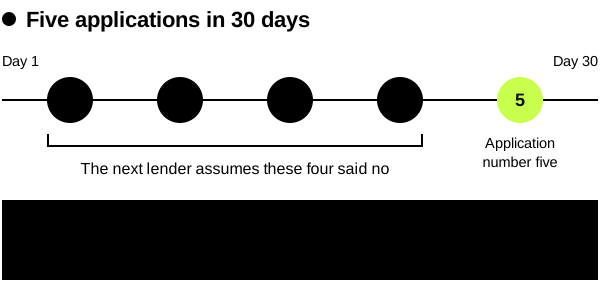
Say you’ve applied for a credit card with five different providers in the last 30 days. Most people apply for a card, get one, and stop. So when a lender sees five applications in a month, they assume the first four said no. To them that looks like someone desperate for credit.
It’s a bit like texting someone five times with no reply. Each message makes the next one look worse.
Spacing out your applications helps, and the recent ones fade with time. But the more useful thing is to find out why you were rejected before you apply anywhere else. Otherwise you’re just collecting rejections.
Using most of the credit you already have
Say you have a card with a $1,000 limit and you owe $900 on it. You know that’s because you just bought a laptop. The lender only sees someone using 90% of their available credit, and that pattern is linked to people who struggle to pay back.
This can happen even if you clear the card in full every month. What matters is the balance that gets reported to the bureau, and if that number is high, that’s what the model sees. Keeping your balances well below your limits is the fix.
If it was a rule
Most people don’t know these rules exist, which is a shame, because this is often the better kind of rejection. If you hit a rule, there may be nothing wrong with your credit at all.
Your income is below their minimum
Some products have a minimum income. If you’re under it the answer is no, however good the rest of your application looks. This is the example from earlier, where the model likes you and you get rejected anyway.
They don’t think you can afford it
Lenders compare what you earn with what already goes out each month, such as rent, bills and other credit. If the new repayments would stretch you too far, they’ll decline. Nobody is forming an opinion about you here. It’s a sum, and either it works or it doesn’t. Usually, this comes from regulation around ensuring lenders are engaging in responsible lending with customers. So, in theory, it is there to protect you.
You don’t fit the product
Some products are only meant for certain people. There can be rules about your age, where you live, whether you’re employed, or a minimum bureau score. It’s like turning up to a club in the wrong shoes. Nothing personal, but you’re not getting in.
What to do about a rule
Don’t reapply for the same product, because the rule will still very likely be there next week. Check the criteria first instead. Lots of lenders list things like minimum income, age or residency requirements, and a different product or lender may have rules you do meet.
If the problem was your details, that’s the easiest fix of the lot. Make sure your name and address are up to date and the same everywhere.
Working out which one it was
Your rejection probably didn’t tell you much. Part of the reason is that a score is a mix of lots of things, so there often isn’t one neat cause to point at. The other part is that lenders don’t publish how their models and rules work, so what you get back tends to be broad. If you think about this for a moment, it makes sense, the lender doesn’t want to give you all the information so that you can game the system, it is ultimately proprietary information.
However, you can usually still get to the underlying reason.
Ask the lender. In many countries they have to tell you the main reason, or at least which credit bureau they used.
Check your credit report. In many places it’s free. The lender sees your report, not your life, so make sure the report is telling the truth. If there’s an account you don’t recognise, or a payment marked as missed that you actually made, raise it with the bureau.
Then compare what you find with the lists above. If your report is clean and your balances are low, a rule is the more likely culprit. If there’s a missed payment from last year sitting on there, you probably have your answer.
Before you apply again
Use an eligibility checker. A lot of lenders have one, and they usually run a “soft search” that other lenders can’t see. You get an idea of your chances without adding another application to your record.
And if you take one thing from this post, find out why you were rejected before you apply anywhere else. A rejection means you didn’t fit one lender’s score or rules on the day you applied, based on what they could see. That can change, and a fair amount of it is in your hands.
I’ll go deeper into each of these in future posts.
This post is general education, not financial advice.